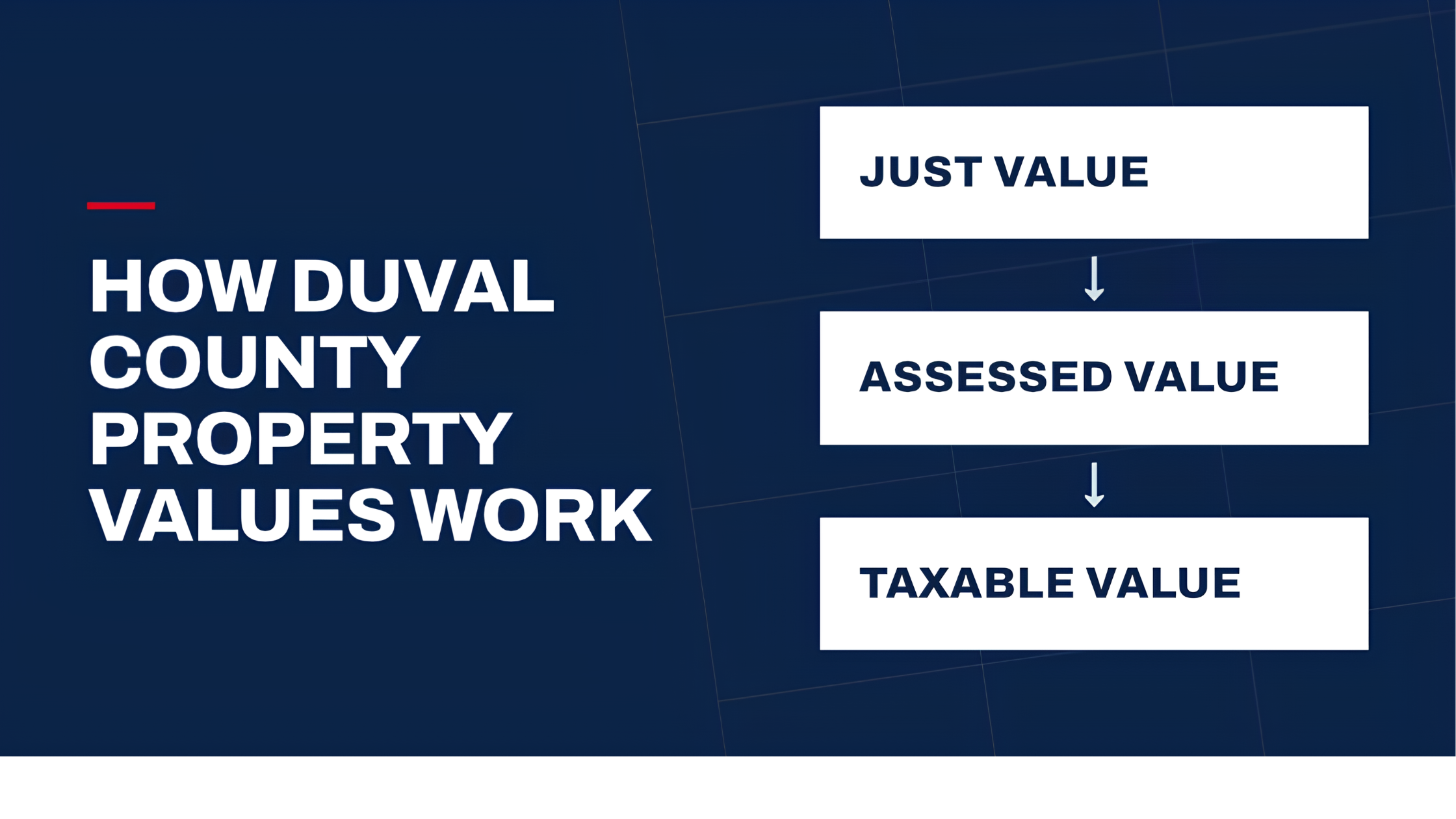
If you have ever looked up your property record in Duval County, you have probably seen several different numbers attached to the same property. Just value, assessed value, and taxable value can all appear on the same record.
They are connected, but they do not mean the same thing.
Understanding how Duval County property values are determined makes it much easier to read your property record, understand your annual assessment, and know which part of the process is handled by the Property Appraiser.
The process starts with just value
Florida property is assessed each year as of January 1. The county property appraiser determines the just value of each property for that assessment date. Florida Dept. of Revenue
You may also hear just value called market value.
Florida law does not say that a property should simply be valued based on the last home that sold nearby. Section 193.011 of the Florida Statutes lists factors the property appraiser must consider when arriving at just value. They include the present cash value of the property, its use, location, size, condition, replacement value of improvements, income from the property when applicable, and information connected to a sale. Florida Senate
That matters because two homes on the same street may not have identical values. Size, condition, improvements, land, use, and other property details can be different.
A property record should give residents enough information to understand the basic facts being used to describe their property.
Assessed value may be different from just value
The next number you may see is assessed value.
For some properties, assessed value and just value can be the same. For others, Florida assessment limits can cause the assessed value to be lower than the current just value.
For homestead property, Florida’s Save Our Homes rules limit how much the assessed value can increase from one year to the next. The annual increase is generally limited to 3 percent or the change in the Consumer Price Index, whichever is lower. The assessed value cannot exceed just value. Florida Dept. of Revenue
That is one reason a neighbor’s property value may look different even when the homes seem similar.
Ownership history, exemptions, assessment limits, improvements, and other facts can affect the numbers shown on a property record.
Taxable value comes after exemptions
Taxable value is another number residents often see.
The Florida Department of Revenue explains the basic sequence this way: the Property Appraiser determines value, applicable assessment limits are applied, and qualifying exemptions are then deducted to arrive at taxable value. Florida Dept. of Revenue
Homestead and other property tax exemptions are administered by the Property Appraiser under Florida law.
The Duval County property search already shows these values separately. A property record may display just value, assessed value, exemption information, and taxable value so residents can see the different parts of the calculation. Pao Property Search
That separation is important. It helps explain why the market value shown on a property record is not necessarily the same number used as taxable value.
The Property Appraiser does not set your tax rate
This is one of the most common points of confusion.
The Property Appraiser determines property values and administers exemptions. The office does not set the tax rates used to calculate the final property tax bill.
Local taxing authorities set millage rates. Those authorities can include county government, municipalities, the School Board, and other taxing districts. The Tax Collector later sends and collects the property tax bill. Florida Dept. of Revenue
So an assessment and a tax bill are related, but they are not the same thing.
A change in assessed or taxable value is one part of the equation. The rates adopted by taxing authorities are another.
What this means for Duval County property owners?
You should be able to look at a Duval County property record and understand what the major numbers mean.
Start with three:
- Just value is the value determined for the property.
- Assessed value reflects applicable assessment limits.
- Taxable value reflects the value after applicable exemptions are taken into account.
Florida property tax law can become complicated quickly, but those three numbers are a useful starting point.
I believe residents should be able to find this information and understand how the pieces fit together without having to become property tax experts.
Take a few minutes to look up your Duval County property record and compare the just value, assessed value, and taxable value shown for your property.